| The Home page of ILPI's Safety Data Sheet (SDS) Resource, the leader in SDS information since 1995! | |
| The history and philosophy behind this resource. | |
| A curated collection of books and reference materials concerning Safety Data Sheets and closely related topics. | |
| Paste your plain text SDS into the SDS-Demystifier, and it will be converted into a hypertext-enriched document with links to detailed explanations of each key term. | |
| An extensive list of frequently asked questions about Safety Data Sheets including regulations, content, compliance, and more. | |
| A humorous take on Safety Data Sheet jargon. Fill in the blanks on our entry form to generate a personalized Unsafety Data Sheet to share with your coworkers. | |
| Since 1995, we've maintained this massive curated list of the best places to find Safety Data Sheets on the Internet. | |
| You are here! Way more than a glossary, this hypertext-enhanced resource covers hundreds of SDS-related terms and expert knowledge. Each entry includes both the SDS relevance and links to additional authoritative resources. | |
| Archived results of Safety Data Sheet related polls taken by some of our millions of site visitors | |
| The OSHA regulations behind SDS regulations, including the inspection guidelines and over 400 official interpretations letters under the Hazard Communication Standard | |
| Commercial suppliers of SDS authoring and management software as well as cloud compliance services. | |
| Commercial companies that will create SDS's for your specific needs as well as SDS translation companies. |

Safety signs, banners, and scoreboards? Get yours at Safety Emporium!
LC-50, 50% Lethal Concentration
Definition
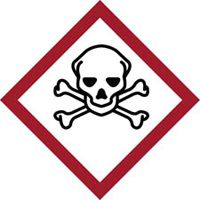
Get your GHS-compliant labels and signs from Safety Emporium.
An LC50 value is the concentration of a material in air that will kill 50% of the test subjects (animals, typically mice or rats) when administered as a single exposure (typically 1 or 4 hours). Also called the median lethal concentration and lethal concentration 50, this value gives you an idea of the relative acute toxicity of an inhalable material.
This is closely related to the LCLo value which is the lowest concentration reported to have killed animals or humans.
LC50 values apply to vapors, dusts, mists and gases. Solids and liquids use the closely related LD50 value (50% lethal dose).
Additional Info
Other variants that are occasionally used are the LC25 and LC75 which refer to the lethal concentration that kills 25% and 75% of test subjects, respectively. The formula for the determination of an LC50 is rather complex and can be found in 49 CFR 173.133(b)(1)(i).
Both LC50 and LD50 values state the animal used in the test. This is important because animal toxicity studies do not necessarily extrapolate (extend) to humans. For example, dioxins (of Love Canal, Times Beach, Sveso and Agent Orange fame) are highly toxic to guinea pigs and ducklings at extremely low levels, but have never been conclusively linked to a single human death even at very high levels of acute (short term) exposure. However, it is best to err on the safe side when evaluating animal toxicity studies and assume that most chemicals that are toxic to animals are toxic to humans.
Typical units for LC50 values are parts per million (ppm) of material in air, micrograms (10-6 = 0.000001 g) per liter of air and milligrams (10-3 = 0.001 g) per cubic meter of air (see volume units and mass units).
New testing regimes, such as the Acute Toxic Class (ATC) and Up Down methods, have been developed which use fewer animals and provide more reliable toxicity class assignments than the traditional LC/LD50 methods. See the links under Further Reading below.
SDS Relevance
LC50 and LD50 values, if known, will be found on Section 11 (toxicological information) of a material's Safety Data Sheet. However, the Hazard Communication Standard does not require any testing when an SDS is created, so just because this data is missing or "not known" does not mean that the material is "safe". If no toxicity information is available, treat the material as potentially hazardous!
Never be exposed to an LC50 dose of a hazardous chemical -- by definition, there is a 50% chance this will kill you...and if you survive you're not going to be in good shape.
Of greater practical use than LC50 and LD50 is the OSHA permissible exposure level (PEL) (if the material has one). This is a more realistic determination of the maximum safe exposure to a material and is usually based on the known effects of the chemical on humans rather than laboratory animals.
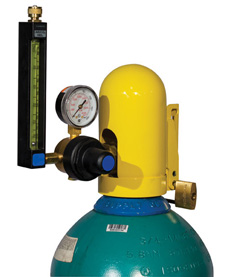
Safety Emporium has a great lineup of gas cylinder signs, storage racks, lockouts, clamps and more.
Further Reading
- What is a LD50 and LC50? at the Canadian Centre for Occupational Health and Safety.
- Visit the Interagency Coordinating Committee on the Validation of Alternative Methods (ICCVAM) for the development, review, and validation of alternative toxicological testing methods.
- Comparing LD50/LC50 Machine Learning Models for Multiple Species from ACS Chem. Health Saf. 2023.
- UCI Toxic Gas Fact Sheet and Standard Operating Procedures (Word download) UC Irvine.
- Compressed Gas: Toxic and Hazardous Gas Classifications at UC San Diego.
- Measures of Toxicity at SUNY Stony Brook.
- List of highly toxic gases at Wikipedia.
- Try your hand at Toxic Trivia here at ILPI.
See also: LD50, mus (mouse), PEL, STEL, TLV.