| The Home page of ILPI's Safety Data Sheet (SDS) Resource, the leader in SDS information since 1995! | |
| The history and philosophy behind this resource. | |
| A curated collection of books and reference materials concerning Safety Data Sheets and closely related topics. | |
| Paste your plain text SDS into the SDS-Demystifier, and it will be converted into a hypertext-enriched document with links to detailed explanations of each key term. | |
| An extensive list of frequently asked questions about Safety Data Sheets including regulations, content, compliance, and more. | |
| A humorous take on Safety Data Sheet jargon. Fill in the blanks on our entry form to generate a personalized Unsafety Data Sheet to share with your coworkers. | |
| Since 1995, we've maintained this massive curated list of the best places to find Safety Data Sheets on the Internet. | |
| Way more than a glossary, this hypertext-enhanced resource covers hundreds of SDS-related terms and expert knowledge. Each entry includes both the SDS relevance and links to additional authoritative resources. | |
| Archived results of Safety Data Sheet related polls taken by some of our millions of site visitors | |
| You are here! The OSHA regulations behind SDS regulations, including the inspection guidelines and over 400 official interpretations letters under the Hazard Communication Standard | |
| Commercial suppliers of SDS authoring and management software as well as cloud compliance services. | |
| Commercial companies that will create SDS's for your specific needs as well as SDS translation companies. |

Safety signs, banners, and scoreboards? Get yours at Safety Emporium!
OSHA Hazard Communication Letters of Interpretation
Clarification on labeling and SDS requirements under HCS 2012.
- Issued
- Record type
- Interpretation
- Historical standard
- HCS 2012 (historical)
- Current standard
- HCS 2024, as amended
ILPI assessment: Useful guidance with important HNOC qualifications
Much of this HCS 2012 guidance remains useful, including non-conflicting supplemental information, ingredient disclosure despite whole-mixture testing, and combining statements without losing required hazard information. Use the current label-element rules and SDS content requirements rather than assuming every 2013 detail is unchanged.
Question 2’s statement about a required HNOC signal word should not be read as creating a universal current requirement. Hazards not otherwise classified (HNOCs) do not require container labeling under paragraph (f)(1); they must be described in SDS Section 2(d). Required signal words for classified hazards still apply. The optional HNOC exclamation-mark pictogram has conditions in C.2.3.3. Question 4’s old Section 2(c) reference for HNOCs is now Section 2(d).
For disclosure, use SDS Section 3 and Section 8; the applicable hazard-specific criteria and below-cutoff health risks matter. Classification based on limited flammability data must follow current flammable-liquid criteria and the available evidence, not an automatic category inferred from a missing boiling point.
Last reviewed: .
About this ILPI assessment
This comparison with current requirements is not a finding that OSHA has formally withdrawn this letter. This assessment reflects editorial judgment informed by human review and AI assistance. It is an opinion, may contain errors or omissions, and is not an official OSHA determination. For guidance on how OSHA requirements apply to your circumstances, contact your local OSHA office.
OSHA's notice about interpretation letters
The following notice is published on OSHA's interpretation pages; it is general guidance, not a letter-specific withdrawal notice.
OSHA requirements are set by statute, standards and regulations. Our interpretation letters explain these requirements and how they apply to particular circumstances, but they cannot create additional employer obligations. This letter constitutes OSHA's interpretation of the requirements discussed. Note that our enforcement guidance may be affected by changes to OSHA rules. Also, from time to time we update our guidance in response to new information. To keep apprised of such developments, you can consult OSHA's website at https://www.osha.gov.
Source: OSHA's original letter page.
January 31, 2013
Ms. Erin McVeigh
3E Company
4520 East West Highway, Ste. 440
Bethesda. MD 20814
Dear Ms. McVeigh:
Thank you for your September 25, 2012, letter to the Occupational Safety and Health Administration (OSHA). Your letter was referred to OSHA's Directorate of Enforcement Programs for a response to your specific questions regarding the revised Hazard Communication standard (HCS 2012), 29 CFR 1910.1200 [ILPI: Original HCS 2012 context · Current HCS]. This letter constitutes OSHA's interpretation only of the requirements herein, and may not be applicable to any questions not delineated within your original correspondence. Your paraphrased questions and our responses are below.
Question 1: Does supplemental information on a label, such as information regarding an environmental hazard or a hazard not otherwise classified (HNOC), need to be physically separated from the harmonized information?
Response: The HCS 2012 [ILPI: Original HCS 2012 context · Current HCS] does not prohibit a manufacturer from adding supplemental information to a label, as long as it does not lead to unnecessarily wide variation or undermine the required label information [ILPI: Original HCS 2012 context · Current HCS]. Therefore, section C.3.1 of Appendix C [ILPI: Original HCS 2012 context · Current HCS] to HCS 2012 [ILPI: Original HCS 2012 context · Current HCS] provides that supplementary information may only be provided if it provides further detail and does not contradict or cast doubt on the validity of the information required by the HCS 2012 [ILPI: Original HCS 2012 context · Current HCS] . The HCS 2012 [ILPI: Original HCS 2012 context · Current HCS] does not specify the format of the label, only the information required on the label. Supplemental information need not be physically separated from the required information on the label; however, section C.3.2 [ILPI: Original HCS 2012 context · Current HCS] provides that the placement of supplemental information must not impede identification of information required by HCS 2012 [ILPI: Original HCS 2012 context · Current HCS] . How a manufacturer designs the layout of the label is up to the preparer, as long as all the required information is present.
Question 2: Is it permissible to include signal words on the safety data sheet (SDS) and label for an HNOC?

Safety Emporium has a wide selection of DANGER signs.
Response: Under section 1910.1200(f)(1) [ILPI: Original HCS 2012 context · Current HCS], HNOCs need not be addressed on an HCS label, and there are no harmonized label requirements for HNOCs. There are only two signal words, "danger" and "warning," under the HCS 2012 [ILPI: Original HCS 2012 context · Current HCS] . Only one signal word may appear on the label and SDS. Under section C.2.1.1 of Appendix C of the standard [ILPI: Original HCS 2012 context · Current HCS], if the signal word "danger" appears, the signal word "warning" shall not. It is not permissible to use signal words other than "danger" or "warning" for HNOCs. The correct signal word for HNOCs must appear on the SDS.
[ILPI note: At issuance: HCS 2012. HNOCs must be described in current SDS Section 2(d), but paragraph (f)(1) does not require HNOC container labeling. This answer should not be used to infer a mandatory harmonized signal word for every HNOC.]
Question 3: Is it permissible to include hazard symbols on the SDS and label for an HNOC, or should information only be displayed as a statement similar to the hazard and precautionary statements adopted from the Globally Harmonized System (GHS)?
Response: The HCS 2012 [ILPI: Original HCS 2012 context · Current HCS] requires the use of up to eight pictograms. The number of pictograms required depends upon the classification of the hazardous chemical. However, the manufacturer may add additional symbol(s) to the label and SDS as long as that symbol is not an HCS 2012 [ILPI: Original HCS 2012 context · Current HCS] pictogram and does not contradict or cast doubt on the information that is required on the label.
Question 4: Can HNOCs be included with other classifications which are described in Section 2 [ILPI: Original HCS 2012 context · Current HCS] of the SDS, subsection (a), or should they remain under their own sub-header on the SDS?
Response: Section 2 [ILPI: Original HCS 2012 context · Current HCS], subheading (a) of Table D.l [ILPI: Original HCS 2012 context · Current HCS] requires the manufacturer to provide the classification of the chemical in accordance with section 1910.1200(d) [ILPI: Original HCS 2012 context · Current HCS]. Section 1910.1200(d) [ILPI: Original HCS 2012 context · Current HCS] delineates the hazard classification process. Paragraph (c) [ILPI: Original HCS 2012 context · Current HCS] of the HCS 2012 [ILPI: Original HCS 2012 context · Current HCS] defines HNOC as:
an adverse physical or health effect identified through evaluation of scientific evidence during the classification process that does not meet the specified criteria for the physical and health hazard classes addressed in this section. This does not extend coverage to adverse physical and health effects for which there is a hazard class addressed in this section, but the effect either falls below the cut-off value/concentration limit of the hazard class or is under a GHS hazard category that has not been adopted by OSHA (e.g., acute toxicity Category 5).
As HNOCs are identified through the section 1910.1200(d) [ILPI: Original HCS 2012 context · Current HCS] hazard classification process, it is permissible to include information on HNOCs under subheading (a).
Question 5: Can Section 16 [ILPI: Original HCS 2012 context · Current HCS] of the SDS be titled, "Other Information," or does it need to have the exact wording, "Other information, including date of preparation or last revision," as specified in 29 CFR 1910.1200(g)(2)(xvi) [ILPI: Original HCS 2012 context · Current HCS] and Appendix D [ILPI: Original HCS 2012 context · Current HCS]?
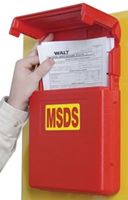
Many of our visitors use these weather-resistant SDS storage boxes like this one. We have 3 different sizes available at Safety Emporium.
Response: The full title of Section 16 [ILPI: Original HCS 2012 context · Current HCS] is "Other information, including date of preparation or last revision." It is permissible to title Section 16 "Other information." However, the information contained in this section must include the date of preparation or last revision in order to be considered complete.
Question 6: What punctuation is required to be used in the SDS? Is it permissible to either use a comma or a period after the headings of each section in the SDS?
Response: HCS 2012 [ILPI: Original HCS 2012 context · Current HCS] does not require that specific punctuation be used in the SDS. It is permissible to use either a comma or a period after the headings of each section of the SDS.
Question 7: Section 8 [ILPI: Original HCS 2012 context · Current HCS] of the SDS requires the SDS preparer to include the applicable OSHA permissible exposure limits (PELs) and American Conference of Governmental Industrial Hygienists (ACGM) Threshold Limit Values (TLVs®). Must the PELs and TLVs® be included regardless of the concentration of the constituent or ingredient? Are they required if the ingredient does not contribute to the hazard classification? If the material has a TLV® and must be listed in Section 8, does it also have to be listed in Section 3 [ILPI: Original HCS 2012 context · Current HCS]?
Response: Under Section 8 [ILPI: Original HCS 2012 context · Current HCS] of Appendix D to the HCS 2012 [ILPI: Original HCS 2012 context · Current HCS] , subheading (a), the manufacturer must list the OSHA PEL, ACGIH TLV®, and any other exposure limit used or recommended by the chemical manufacturer, importer, or employer preparing the safety data sheet, where available. The requirement to include PELs and TLVs® in Section 8 of the SDS applies to any constituent or ingredient (including additives and impurities) that is present in the mixture or - substance above its cut-off value, or if it is below the cut-off value but still contributes to the hazard classification of the material. Please see the answer to question 8 for more details about contributing to the classification of the material. If a constituent is not present in the mixture or substance above its cut-off value, and does not contribute to the hazard classification of the substance or mixture, the PEL and TLV® associated with the ingredient need not be listed on the SDS. The lists of constituents in Sections 3 and 8 [ILPI: Original HCS 2012 context · Current HCS] must be the same. If the constituent does not have a TLV® or PEL, its recommended exposure limit must be listed as "not applicable (N/A)" or "none."
Question 8: Is it still required to include information on the SDSs concerning components that could release above the TLV®, OSHA PEL, or that present health risks? The HCS 2012 [ILPI: Original HCS 2012 context · Current HCS] seems to only require listing components in Section 3 [ILPI: Original HCS 2012 context · Current HCS] that contribute to health hazards and are present within the product above the concentration cut-off.
Response: Section [ILPI: Original HCS 2012 context · Current HCS] 3 of Appendix D [ILPI: Original HCS 2012 context · Current HCS] to HCS 2012 [ILPI: Original HCS 2012 context · Current HCS] states that if the hazard of an ingredient presents a health risk below the applicable cut-off value, it must listed. It is OSHA's longstanding position that where a component may be released above an OSHA PEL or the TLV®, it presents a health risk, and must therefore be included on the SDS. Where a component of a product may be released in concentrations that would exceed an OSHA PEL or the TLV® information on these components must be included, regardless of whether their concentration in the product is below the cut-off value.
Question 9: Are the hazard and precautionary statements that appear in Appendix C [ILPI: Original HCS 2012 context · Current HCS] mandatory, or is there flexibility in capitalization, word changes, etc.? There are a number of hazard and precautionary statements that appear in Appendix C that do not exist in the 3rd edition of the GHS. Can the GHS statements be used instead of the HCS statements? For example, can GHS precautionary statement P272, contaminated work clothing should not be allowed out of the workplace
be used instead of the statement in Appendix C, contaminated work clothing must not be allowed out of the workplace
?
Response: The hazard and precautionary statements that appear in Appendix C [ILPI: Original HCS 2012 context · Current HCS] under Sections C.2.2.1 [ILPI: Original HCS 2012 context · Current HCS] and C.2.4.1 [ILPI: Original HCS 2012 context · Current HCS] are mandatory. However, C.2.2.1 [ILPI: Original HCS 2012 context · Current HCS] allows hazard statements to be combined where appropriate to reduce the information on the label and improve readability, as long as all of the hazards are conveyed as required. Likewise, C.2.4.6 [ILPI: Original HCS 2012 context · Current HCS] also allows for the combination or consolidation of precautionary statements to save label space and improve readability. OSHA does not require specific capitalization in the format of the statements.
As stated previously, the hazard and precautionary statements are mandatory, and therefore the GHS hazard and precautionary statements cannot be used instead of those required by HCS 2012 [ILPI: Original HCS 2012 context · Current HCS] . The GHS is guidance; the HCS 2012 [ILPI: Original HCS 2012 context · Current HCS] is a mandatory standard. When the HCS 2012 [ILPI: Original HCS 2012 context · Current HCS] was promulgated, the GHS statements were modified to reflect the mandatory nature of the standard.
Therefore, statements that were written in the GHS as "could" or "should," were revised to have mandatory language such as "must" or "shall."
Question 10: What is the proper classification of a chemical that has a flash point less than 22 °C but the boiling point has not been determined?
Response: OSHA does not classify chemicals for manufacturers. However, your question raises the point of how to classify a chemical if all the information needed to follow the HCS classification requirements is not available or is unknown. The HCS 2012 [ILPI: Original HCS 2012 context · Current HCS] does not require testing of chemicals, however, manufacturers are permitted to test their product. Manufacturers must base the classification of the flammable chemical on the information about the chemical that is available. If sufficient data is not available, professional judgment must be used. This should be documented and subsequently reviewed when more information is available.
Thank you for your interest in occupational safety and health. We hope you find this information helpful. OSHA's requirements are set by statute, standards, and regulations. Our letters of interpretation do not create new or additional requirements but rather explain these requirements and how they apply to particular circumstances. This letter constitutes OSHA's interpretation of the requirements discussed. From time to time, letters are affected when the Agency updates a standard, a legal decision impacts a standard, or changes in technology affect the interpretation. To assure that you are using the correct information and guidance, please consult OSHA's website at https://www.osha.gov. If you have further questions, please feel free to contact the Office of Health Enforcement at (202) 693-2190.
Sincerely,
Thomas Galassi, Director
Directorate of Enforcement Programs
The original official public domain version of this document is available from OSHA at https://www.osha.gov/laws-regs/standardinterpretations/2013-01-31-0.